-->
Showing posts with label behind the lens. Show all posts

Monday, February 7, 2011

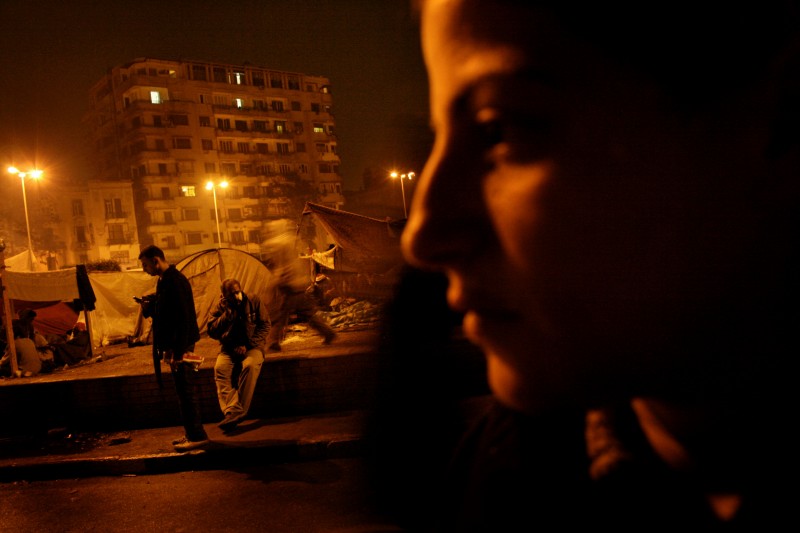
Beyond the obvious: images from Egypt


© 2011 Laura El-Tantawy/ALL RIGHTS RESERVED

I'm sure many of us are following the developments in Egypt. We're inundated with thousands of images chronicling the anti-goverment protests. Most of them being moved by the wire services are just what you would expect. Violent clashes. Danger. Drama.

There is another side to these protests. A more human side. And some photographers are doing their darnedest to chronicle that, as well.

I ran across some of these image at burn. magazine, an on-line photography site curated by great Magnum and National Geographic photographer David Alan Harvey. The photographs are by Egyptian photographer Laura El-Tantawy, who also writes about her experiences while covering the protests.

Visually, these photographs are haunting and atmospheric. We get to see the faces and begin to understand some of the participants in a much more intimate way than the rock'em sock'em wire photos allow.

As El-Tantawy says:

"Tahrir (Liberation) Square has become a microcosm of Egyptian society. The protesters here represent all classes of people, from the art world, politicians, engineers, lawyers, bankers, school teachers, government employees, construction workers, plumbers. They all came here to fight for something."

The best photojournalism not only addresses the "what," but also the "who" and the "why." The best photographs are the ones that move us. The ones that appeal to our humanity, whether the subjects are halfway across the world or right here in our own backyards.

Take a look. Tell me what you think. What images have you viewed from Egypt, and which ones stick with you? Why?

Link: Cairo: Quest for Liberation


Friday, December 24, 2010

Words and pictures make merry ...


Cari Shelkoff, 23, right, and sister Jules, 20, wrap gifts for last-minute shoppers at Statseboro Mall on Christmas Eve.

Christmas Eve. The paper was going to press extra early (noon-ish) so employees could spend holiday time with their families. So I'm searching for a photograph to anchor our front page on Christmas Day.

At first, I was loath to enter Statesboro Mall to photograph last minute shoppers. Personally, I think we've published plenty of pics featuring Santa Claus and shoppers this season. However, after fruitlessly cruising in hopes stumbling across something more unique, I yielded to the looming deadline and entered the mall.

I was rewarded with a fortuitous gift of circumstance. I stopped at a gift wrapping booth where three women worked at a feverish pace. I started making pictures, hoping to capture a bit of the frenzy. As I shot, though, I listened.

And I learned that the booth was run by two sisters in their early 20s (with some help from Mom). This was the ninth year in a row that they've served the needs of holiday shoppers.

Without breaking their stride, the stories flew forth. Before I knew it, I had stopped shooting and was writing in my notebook. The seasonal entrepreneurial effort had helped put the two girls through college. It had helped pay for their cars and gas. It had helped fund trips, including a recent one to Israel.

The business was clearly lucrative, but there was more. The girls clearly loved what they were doing.

Sure, they smiled as they took money for their services. Clearly there was commerce involved. But they weren't just wrapping gifts. They were engaging their customers. Swapping stories and experiences. Giving advice. Even giving directions.

When they directed their stories to me, I scribbled and they continued working.

Their favorite regular questions?

"Do you wrap gifts here?" (Yes, they really get that one frequently.)

And "What should I get for my wife?"

Sometimes, they wish some folks would take their advice on that one, too, as they shared a story about a man who came in on a rainy Christmas Eve and was stumped about what to buy for his wife. He ended up buying an umbrella, a rain coat, and rain boots. The sisters held their tongues as they wrapped them for the poor fellow. Not to mention the guy who bought his wife cleaning supplies for Christmas. "She loves to clean," he said. They, again, held their tongues at the time but laughed as they shared the story.

They told me about some of the most unusual/challenging gifts they wrapped, including a bicycle and a basketball goal.

They said they were touched when a woman recovering from a brain tumor brought her gifts in to be wrapped because she couldn't kneel on the floor anymore. They were impressed by her spirit to share despite her difficulties.

They shared their secret to successful gift wrapping: patience and tape. Lots of tape.

It was obvious that their people skills were integral to their success, as well.

The entrepreneurial and holiday spirit do indeed mix well together.

What I ended up with was an okay picture but a great story, so I hustled back to the office, processed my photographs, and wrote a short story in about fifteen minutes. Just in the knick of time before the paper was sent to the press.

I'm not a writer by trade, especially on deadline. But I managed to crank out enough text that the story had to be jumped from the front page onto an inside page. Whew!

The lesson is that words and images always work together to tell the stories of our community.

Gifts come in all shapes and sizes. This is mine, to you, today.

Merry Christmas, all!


Monday, December 6, 2010

How the pros do it: Way rad surfing shots


Are you an aspiring sports photographer? This is a great video that gives us some insight to how the real pros do it. Real hard core photo geeks might appreciate it more, but anyone who's interested in how great images are made might enjoy watching this as well.

I ran across this on David Hobby's Strobist blog: Hangin' Eight, with Dave Black.

It's a great lesson in how pro photographers are using the latest in wireless lighting technology to produce pictures that really stand out from from the pack. Black walks you through his setup. It's really impressive and enlightening (pardon the pun).

Still intrigued? To get started making these kinds of images, all you need is $5,000 in lighting equipment, a $4800 digital camera, and a $5,800 lens. And an assistant. Oh yeah, and a few years of practice to learn how to use all that equipment and – most importantly - develop an understanding of light, composition, and the necessary sense of timing to capture those great moments.

Are you game?

A comparison of images without, left, and with remote flash. © David Black Photography.

© David Black Photography

Images are the property of David Black Photography and all usage is subject to United States and International Copyright law. ALL RIGHTS RESERVED.


Tuesday, November 16, 2010

Shots that make you go Hmmmmm ...

Mercer's Sharnea Boykin, left, gets the worse of a collision with Georgia Southern
guard Jamie Navarro during the second half of Tuesday's game at Hanner Fieldhouse.

Okay. I love shooting sports, and I'm fairly competent at it. Now, I'm not Bill Frakes–Walter Iooss–John Beiver good. That's crazy good. Those guys just never seem to miss anything, while I still have plenty of times where I never seem to be in the right place at the right time. Especially this year – my gear seems to draw referees like flies. I just can't begin to tell you how many great moments I've captured that are hidden behind black and white stripes. But every once in a while, I can still pull off a doozy.

And I almost didn't get this one because I was contemplating leaving early with the Lady Eagles comfortably ahead by 20+ points in the second half. I did leave, though, after I checked my images while Jamie Navarro shot her free throws. I blew the smoke off the barrel of my lens and got the hell out of Dodge.

This is the beauty of still photography, too. Video would have captured a nasty collision in real time. Sometimes, slow motion can convey something we miss in real time, but it is also fleeting and linear. Only still images can communicate the merging of elements that create something unusual, surprising, and memorable.

Anticipation plays an incredibly important role in photography. It's what separates the best from everyone else. Some things, however, you just can't anticipate, and you look forward to the surprises. You never get tired of that.

Ask anyone who's been doing this for a long time what the best part of the job still is, and they'll probably tell you – it's those shots that make you go hmmmmm.


Saturday, November 6, 2010

GSU win trumps all


My wife called it.

With the Georgia Southern football team seemingly out of the playoff hunt with four losses, there were lots of story lines that might have produced a front page picture.

Homecoming. The annual Blue-Out, where most folks dress out in team colors and some paint their bodies from head to toe. Being the last home game of the season, the senior football players were honored. Not to mention the nippy fall weather that had folks huddling together in their coats and blankets.

No shortage of possibilities for a front page photograph.

While alumni were out in full force, the visual presence of Homecoming wasn't so apparent, and I mentioned that to my wife before we both went about our busy work days. And, being the loyal Georgia Southern fan she is, she quipped "When the Eagles beat App State, then you'll have a front page picture!"

I smiled. Georgia Southern has struggled to return to the heights of their glory since their last Football Championship Series (FCS, formerly Division 1-AA) Championship in 2001, their sixth title overall. Since that time, they have watched Appalachian State become a perennial powerhouse and championship contender, winning three straight titles of their own from 2005-2007. Today, the Mountaineers were the number one ranked team in the country and the Eagles were supposed to be a minor speed bump on the way to another championship run.

So I went about finding a way to tell the stories of the day surrounding the game as App State raced to a 14-0 lead.

But the Eagles refused to act like a speed bump. With the Mountaineers threatening to take a 21-0 lead in the second quarter, they came up with an interception in the end zone. Then they scored with only seconds to go before the half. Then they came out after the break, marched down the field, and scored again. 14-all.

The rest of the second half was a slugfest in which the defenses dominated. Regulation ended with the game still tied up at 14. The Eagles scored a touchdown on their first possession in overtime. Then they forced a fumble by the Mountaineers quarterback and recovered it. Game over. Stadium erupts in celebration. Got my front page picture.

Good call, my love!


Georgia Southern fullback Robert Brown (5), center right, celebrates a four-yard touchdown in overtime against number-one ranked (FCS) Appalachian State at Paulson Stadium in Statesboro, Ga.  Saturday.

Thursday, October 28, 2010

A camera is just a tool, right?


Good light and composition are not dependent on gear.

I get it all the time. I'm out working, and inevitably someone will take a look at my gear and say "I bet that camera takes good pictures."

Well, no, I counter. A photographer takes good pictures. The camera is just a tool. I tell that to anyone who enquires about taking better photographs. I preach it to my students when I teach classes. A photographer understands how to use light and thoughtfully compose an image. A photographer chooses when to press the button and capture a particular moment in time. Owning a nice camera does not make you a photographer.

I might have to eat some of those words.

You can build a house with a hammer and a saw, but you can build one a whole lot more efficiently with some power tools.

For the past couple of weeks, I feel like I've been working with a hammer.

My trusty Nikon D300 wigged out on me. The mirror locked up and the camera essentially became non-functioning. It was my only working body, too, my other one being an old D2Hs with a fried image sensor functioning only as a lens holder. (Useless, unless images with a sickly hot-pink magenta cast are the look you're going for) To simply do my job, I've had to borrow a camera from the Connect Statesboro staff. I'm grateful to them, but it's been an exercise in frustration.

The camera I borrowed is a Nikon D40x, which was the entry-level digital SLR in Nikon's lineup (since replaced by the snazzier D3100). To be sure, it's cable of making fine images within its limitations. But make no mistake: it has its limitations.

Many folks appreciate lightness in a camera body. It's sure a lot easier on my shoulders and neck. But a little heft has its advantages. A heavier body acts as a counterweight against heavier professional-level lenses. The D40 looks and feels downright silly with a 70-200 mm f/2.8 telephoto zoom lens mounted on it. Plus, the camera is made of flimsy plastic. Camera equipment tends to get knocked about in the course of covering news assignments. The build does not inspire confidence.

Like I said, this camera is capable of making good images. I shot a fairly bang-up portrait for the cover of one our monthly publications. Light and composition are two of the three most important elements of good photography. That part never changes, regardless of your gear. The third – timing – is where I consistently have experienced frustration. And, in photojournalism, I can't think of anything more important than timing.

Missed a funny moment while D40 searched for focus

I'm accustomed to a camera responding instantly. I shoot a frame, and the D300 was instantly ready to shoot another. If I needed to shoot a burst of frames, I've had up to 30 or so frames available, at 8 frames per second, no less. Not so with the D40. Sometimes, there is a lag when I press the shutter release. Sometimes I have to wait before I can shoot again. Nikon claims "instant response time" and "3 frames per second burst rate," but I beg to differ.

Plenty of light? No problem. Typical human movement? Sufficient. But news photography frequently requires shooting action in low light. Thank goodness all of our local high school and college football teams were playing out-of-town games last weekend. Still, I was cursing as the D40 struggled to make in-focus, properly exposed images at a Halloween haunted house.

So, if you ever wondered what you get when you spend megabucks on a digital camera, this is what differentiates a model with pro features from an entry-level camera:

  • Durable build. When you drop big bucks on a camera, you should expect something that can take a reasonable beating. The camera body itself will outlast the electronics that make it function. (e.g. my D2Hs) Higher end models come with a degree of weather sealing, too, to keep moisture and dust from invading the electronics inside your camera. Not water-proof, mind you. I wouldn't suggest shooting with any sophisticated electronic cameras in a driving rainstorm. But a gentle sprinkle shouldn't make your gear lock up.

  • Processing power. A digital camera is essentially a mini-computer, and you can expect the same difference in performance that you would between a $500 computer and a $5,000 computer. Every camera function is dependent on processing power, from responsiveness, to autofocus speed, to image processing, etc. An entry-level DSLR is just fine for most folks. But when you need to make a couple thousand images in one day ( and sometimes I do), you need something more robust.

Those are the main things, but some other niceties come with a bigger price tag. Ergonomics and convenience, for example. Instead of having to scroll through endless menus to change certain settings, pro models have lots of buttons and dials right at your fingertips to quickly make adjustments. You get what you pay for.

Perhaps I needed to spend more time with the D40x to squeeze the most out of its potential. It's the kind of camera that would suffice more many, or most, photography enthusiasts. In fact, it would be a great used purchase for those looking to step up from a point-and-shoot. It's not a power tool, however. (Well, maybe one of those off-brand power tools you can buy at discount stores.)

My equipment breakdown has expedited the approval by our corporate folks for a new D300s camera body, which should arrive in the next day or so. Just in the nick of time, because there are football games Friday and Saturday with playoff implications. Having two camera bodies is not a luxury for a photojournalist, either. Backup is not the only consideration. I lament the countless pictures I have lost because I was switching lenses. To that end, I should get my trusty D300 back from the repair shop fairly soon, too.

I can't wait, because it sure takes good pictures.


Tuesday, October 26, 2010

"a small voice" goes mobile


I'm keen on irony.

After posting about the virtues of print, or "Legacy," media, I decided to make a small voice more mobile friendly. If you would like to read a small voice on your mobile phone, click on the a small voice MOBILE SITE link. Bookmark it and stop in where ever you are, now.

And comment! I want to know what's on your mind. Journalism is a conversation, folks!


Friday, October 8, 2010

Knowing when to say when ...

ECI running back Darion Moody, center, leaves Poral defenders
flailing on a 64-yard touchdown run on 4-and-2 when the
Bulldogs were trying to run out the clock just before halftime Friday.

There's a certain amount of guilt that goes along with being a one-man photo department at a small newspaper.

You can never adequately cover your community. The news is 24/7. It never stops. You end up having to make choices and sometimes compromise your journalistic ideals. Sometimes you're the one putting in the 14 hour work days, and sometimes it's your co-workers, and you feel guilty when it's not you. And you're constantly juggling that sense of professionalism and commitment with family and activities outside of work. It's a hard, if not impossible, balance to achieve.

Today, I spent most of the day with my sick 3-year-old. I didn't get in to the office until most folks were just kicking off for the day. I knew I was okay, because the only thing I had to shoot was Friday night high school football. Still, most of my co-workers had already been working at least half-a-day, and several would be working past 11:00 p.m., either web-casting the game, writing game stories, or putting together the newspaper for the next day. So, when I decided to bug out of the ball game at halftime, there was a twinge of guilt.

Some folks don't understand shooting sports. "Can't you get one good shot and then leave, since it's likely only one shot will be published in the paper?" they say. But it's not about getting a shot. It's about getting the shot. About telling the story of that game. Or at least a small group of photos that capture its essence.

I hate to leave a game early because of that. You just can't count out some kind of crazy turn of events that results in a monumental comeback. It's rare, but I've seen it happen, and I feel it would be professionally remiss to skip out on a game early just because I have a couple of good action shots. My worst nightmare is to leave a game early, have something unlikely happen, and not be there to capture the real story.

Tonight was not one of those times. The score was 42-0 at halftime. So, with both my wife and I facing long work days on Saturday – on our wedding anniversary, no less – and a feverish toddler, I left at halftime tonight.

So, with sincere apologies to Portal High School, my co-workers, and Statesboro Herald readers ...

WHEN!


Portal's Deontre Williams is slow to get up off the field after having his punt blocked by ECI's Wezley Ealey in the second quarter Friday.

Monday, October 4, 2010

Facing loss

Sometimes, photographs are the best way to tell a story. But they have limitations.

One of my assignments last week was to photograph Connie Sacks, whose husband, a former soldier and contract medic with a government agency, was killed during a Taliban ambush in Afghanistan in July. She was clearly still in shock and emotionally raw. Despite that, she shared her story with the Herald. She shared the story of his life, his heroic actions after being mortally wounded, as well as their love story – one for the ages.

How do you show that, with a photograph, during a short interview in her living room? You can't. Photography is best used to create emotional connections. So I knew I had to craft an image that was emotional.

When I first entered the living room, I noticed how the soft window light created a distinctive mood in the room. I knew I could use that to my story-telling advantage. I listened as writer Holli Deal Bragg asked questions and listened to the responses. Connie alternatively beamed with joy and choked with tears as she recalled her life together with husband Max. He was all around her. In the home they renovated together. In the yard they got married in. In the furniture he restored. In the seashells they collected. All the while, she clutched his military dog tags that she wore around her neck.

Personally, I hate to shoot over-posed, directed portraits. But I knew I would have to do a little coaching in this instance. I posed Connie by the window to take advantage of the light. And I told her how to hold the dog tags, which hung near her waist, so I could photograph them close to her face and still maintain a natural feel. She was nervous to be in front of the lens. In the end, though, I really didn't have to do much. Almost immediately, she gazed at the object and began to reflect. I had my shot before she even had a chance to get uncomfortable and think about what we were doing.

So, yes, this is a posed portrait. Not my favorite thing to do, especially under the circumstances. But it couldn't be more honest or more real. I hope it's a suitable tribute to both Connie and Max.

Sometimes folks ask me what you say to people under those circumstances. In this case, I thanked Connie. Sharing her story was courageous, and it's a service to our readers and our community. Grief will touch us all at some point in our lives, and we can learn from how others cope.

And we remember those we've lost through those who remain.


Sunday, September 26, 2010

Hindu deity makes a clutch grab in Georgia Southern win

Who needs Photoshop?

I swear, this is totally real. It's simply the result of being in a particular spot at a particular moment in time. Shoot enough frames, you're bound to come up with some surprises.

Georgia Southern wide receiver Mitch Willford made a clutch reception on fourth down in the fourth quarter against Elon that allowed the Eagles to run out the clock. He celebrated, as did offensive lineman Zach Lonas. Their bodies and arms lined up in way you could never have planned for. It's phenomenon totally unique to still photography.

Anyway, a four-armed receiver ought to haul in anything that comes his way.

Thursday, September 23, 2010

Family trumps politics

Mary Matalin expounds on her daughter's occasional opinion of daddy
James Carville, background left, during Wednesday's appearance at
Georgia Southern University's Hanner Fieldhouse. 

Political power couple James Carville and Mary Matalin brought their He Said/She Said act to Georgia Southern Wednesday.

 The two may disagree on politics, but I was able to capture a moment when they whole heartily agreed – where Matalin described how their daughters can be mightily embarrassed by their Dad's antics as a New Orleans Saints fan and proud Louisianan.

Uh, loser!

Wednesday, September 22, 2010

Touchdown Jesus, Southern style ...

I'm sure many of you are familiar with the famous football icon at the University of Notre Dame known as "Touchdown Jesus."

Well, my colleague at the Morgan County Citizen, Angelina Bellebuono, e-mailed me a pic that's almost unbelievable, at the same time not surprising. It kind of speaks volumes about football, religion, and the South. What's funny is that Angelina didn't know she made this image when she pressed the shutter button.

She was simply doing what many of us news photogs do when shooting sports. That is, shooting pictures of the scoreboard after important plays to mark the score, time, down and distance, etc. to help with captioning later on.

"When I began editing, I realized I was looking at DaVinci's 'Last Supper.' Without the supper. I never saw it as I was actually shooting the image," she said in her e-mail.

It kind of reminds me of religious apparitions you hear about on occasion. You know, like the Virgin Mary appearing in a cloud formation or a potato chip shaped like Jesus.

Angelina wondered if it was subliminal. I say not. There's nothing subtle about religion and football here in Georgia.

Some might say they are one in the same.

Saturday, September 18, 2010

Politics aside ... I am a biased journalist

I'm not much for politics. Sure, I've got my opinions. Plenty of strongly held ones, too. But I keep'em to myself when I'm on the job. You know, in the interest of fairness and accuracy, which are the true benchmarks of professional journalism, not the ubiquitous, misunderstood, and misapplied term "objectivity."

When I'm covering political events, the story I always try to tell is the human interest angle. In the interest of fairness, I'll tell you straight up that my personal bias in my work is that of humanity. One of the great advantages of using photographs as a means of communication is that we can see ourselves in other people, regardless of cultural, political, religious or personal beliefs.

In our increasingly polarized political atmosphere (and I admit that's an opinion based on my personal observations), I'm always looking for little nuggets of humanity. When Michael Steele, chairman of the Republican National Committee, visited Statesboro Saturday as part of his "Fire Pelosi" tour to stir up participation in November elections, the political electricity in the air couldn't be felt more strongly.

At the end of Steele's speech, a citizen reminded him to address an issue of great importance to her. Honestly, I couldn't really understand much of anything she said from my vantage point, but she was clearly feisty and her comments elicited side-splitting laughter – especially from Steele himself. Did I mention doubled over with laughter?

She was asking Steel for a definitive statement on whether or not the Republican National Committee was going to support Christine O'Donnell, the surprise winner of the Republican primary for a Senate seat in Delaware. In other words, she was holding the leader of her political party accountable, and she was doing it with humor.

Is there anything much more human than humor? Any time we can see opponents, adversaries, or anyone different from ourselves as the human beings that they are, well, I think there is great hope for humanity itself, because that is the starting point for any progress.

So there it is. My bias. Sue me if you don't like it, but don't say you weren't advised.

By the way, Steel said he and the National Party have started transferring funds to O'Donnell's campaign and would support her in every way.

I am a journalist, after all.

After his speech during a stop at the Holiday Inn in Statesboro on his "Fire Pelosi" tour, Republican National Committee Chair Michael Steele doubles over laughing at the spunkiness of Hazel Jordan of Savannah, right.

Monday, September 13, 2010

September 11th in 2010: here, there, and everywhere ...


This is how our local Statesboro and Bulloch County public safety officers honored their own on Saturday, September 11, 2010.

Tim Grams of the Statesboro Fire Department, left, rings a bell to honor safety officials who lost their lives on September 11, 2001 during a ceremony at Bulloch Memorial Gardens Saturday.


And this is a link to one of my favorite photo blogs, The Big Picture by the Boston Globe, which features many pictures from many sources about how people remembered 9/11.

The Tribute in Lights illuminates the sky over lower Manhattan on September 11, 2010. (REUTERS/Gary Hershorn)

Wednesday, September 8, 2010

'Tis the season: multimedia slideshow

It's become a marker of fall for me. Georgia Southern football and multimedia.

On Saturdays, I lurk amongst the tailgaters with my funny looking Zoom H4 audio recorder (looks a little like a stun gun).

On Monday, I start perusing through over 1000 images shot at the game and listening to the audio I recorded. Then I start to play around with music loops in Apple GarageBand until I have some music appropriate to set the stage.

Mix it all together with Joe Weiss' amazing little Soundslides program, and voila!

Hopefuly, something a little better than a clicky-click slideshow. Perhaps something that captures a little more of the energy at Paulson Stadium?

Soundslides is pretty amazing. It produces an Adobe Flash-based slideshow which looks way better than a typical on-line video. Check out the full-screen mode by clicking in the bottom-right hand corner.

Tell me what you think.

Saturday, September 4, 2010

1980s madness ...


Okay, I feel really old.

 After the Statesboro High School marching band performed their '80s Madness routine at halftime Friday night, Tyler Smith, 17, told me I was one of the few people who recognized he was portraying Slash of Guns-n-Roses.

"People were coming up to me and saying 'Hey Ozzie!'"

Madness, indeed!

Thursday, September 2, 2010

Football madness: stories from the sidelines

Portal's Nolan Clark lies prone on the field after cramping up on a 
Southeast Bulloch kickoff return.

As a photojournalist, my main job is to tell the stories I cover through photographic images. Sometimes, additionally, the access afforded photographers gives us a chance to make observations and share stories of the non-visual variety. The sidelines at sporting events can provide some unique experiences and perspectives not always accessible to most fans and even sports writers who tend to stick to the press box.

Our first Friday night football game of the 2010 season featured Southeast Bulloch and Portal high schools. Tons of story lines. Two local, cross-county rivals playing each other. Two new head coaches, to name a couple. From a news standpoint, last Friday was a can't-lose situation. On the field, however, somebody had to lose.

In the end, Southeast Bulloch won in convincing fashion, 37-12, snapping a 19-game losing streak in the process. The story in the following day's paper reflected the significance of that feat, as well it should have. They exercised a demon and set a new tone for the future of their program.

But there was another story line that emerged on the sideline which was discussed amongst us in the local news media and was also reflected in my photographs as I edited them later. It's an issue that most every small school struggles with when competing against larger schools. Sometimes football is a game of attrition as much anything else.

Portal's Jordan Cowart, one of the many two-way players for the Panthers, 
walks slowly off the field after a turnover against Southeast Bulloch.

Portal High School head football coach Cherard Freeman.

When the two teams put their best 11 players on the field against each other, there wasn't a great deal of difference in talent – if any. But when you looked at the sidelines, SEB's advantage was evident. The Yellow Jackets dressed out possibly three times as many players as the Panthers. While SEB has its share of two-way players, Portal players almost never came off the field, with practically the same 11 playing defense, offense, and special teams. That takes its toll, especially on the big guys in the trenches. Add in South Georgia heat in August, and that's a lot to overcome. More than once, there were multiple Portal players cramping up on the field between plays.

So what's the point of this post? There's certainly no slight intended towards Southeast Bulloch. They earned their win and I look forward to covering them. I hope the Portal players aren't embarrassed. I expect them to be very competitive against teams in their own region. They have some players who can "ball" and a coach who really likes to teach the game of football.

The point is that sometimes pictures can tell a part of the story that might not make it into the gameday story. And sometimes I like to pass on what I see and hear while working the sidelines.

More to come ...

Portal quarterback Hunter Oglesby led all rushers with 137 yards against
Southeast Bulloch.

Saturday, August 14, 2010

High temps not conducive to creativity

Jennifer Burnett,18, of Dahlonega gets a ride from
childhood pal Tracy Bardugon, 18, as the two move
in to campus housing at Georgia Southern University.

I've been trying to teach my two-year-old to share. This week, he shared a virus with me.

The result has been a triple-digit temperature, matching the triple-digit temperatures outdoors in South Georgia this past week.

I took one day off, trying to recover – to no avail. With community events piling up, I returned to work in time to cover Friday's "Operation Move-in" at Georgia Southern University. The official opening of campus housing to new students is something we cover every year, so I usually try to think up a new angle each time. The blazing heat seemed like a pretty logical one, this time.

Now, I can be pretty stubborn. I'm always trying to push myself by attempting to make pictures I've never made before, no matter how mundane the subject. I'll work some events long and hard, almost beyond reason, just to come up with an image that's not hackneyed or cliche. I'm not always successful. Not successful nearly as often as I would like. But I always make the effort. It's just not in my nature to mail in any assignment.

Friday was chock full of story-telling opportunities: Two life-long friends become roommates for their first year of college. After a commuting, long-distance relationship, a high school grad finally joins her boyfriend as a Georgia Southern student. Four people tote an entire shoe collection for a rising freshman moving into campus housing.

Catherine Lee, 18, of Atlanta affectionately punches boyfriend

Michael McFarland, 21, Friday during Operation Move-In at

Georgia Southern. 

But my body and mind just weren't up to the task. My muscles ached. I was constantly wiping sweat from my eyes. Yet, my vision seemed to get no better after I wiped them. My brain was hazy – no sense of timing or composition. I was mindlessly making frames, hoping one might tell an interesting story. Rather than sticking with any particular subject for any length of time, I quickly bowed out and moved on.

Dyree Scott, left, and brother Ben help Savannah pal 
Jamari Mixon move into Eagle Village by toting his 
shoe collection.

After shooting several different scenarios, I wasn't particularly happy with any of my images – a lot of them had that "almost-but-not-quite-good" quality – and realized I hadn't really communicated what was so apparent - the heat. Those fleeting moments, where someone paused and wiped their brow or took a sip from a water bottle, were completely escaping me. I was still resolved to try and make some type of image to communicate these oppressive dog days conditions.

However, in this case, dog days did not translate into dogged determination. I was just dog tired.

The tipping point came when one of the event volunteers saw me. "You look really hot. Are you okay?" And she offered me water and and a towel.

And then it happened again, as I made my way. "Man, you look hot. Are you okay?"

And again. And again ...

Even in my dazed and confused state, I got the message. Time to bag it, Scotty B. You've become a reptile (and not a cute one like that gecko on TV), unable to regulate your body temperature in these conditions. Find a rock to crawl under – quickly.

So I trudged back to my car and left for the office to turn in the pictures I did manage to make.

Lesson learned? Well, I tried to tough things out, but toughness doesn't always translate into creativity. Sometimes, you gotta know when to say "when."

Can I go to sleep, now?


Monday, August 2, 2010

The eyes of the beholder: more on contests ...

1st place Feature Photo and Photo of the Year, 2009 Georgia AP Awards, Division A.

There's been another round of annual contest awards, and it might be worth further examining their significance, which I began to do in this post: The award is not the reward.

There are two main press associations in the state of Georgia that conduct annual contests: the Georgia Press Association and the Georgia Associated Press Association (this link is dated, but the best I could find.) The GPA contest is open to every newspaper in the state. The Georgia AP contest is open to members in the state who subscribe to the AP wire service, so many smaller papers are not represented. Both contest have this in common – they are broken down into divisions so that papers with similar circulations are competing against one another instead of with everyone in the state. The Statesboro Herald competes in the Division D (Circulation 8,000–under, daily newspapers) in GPA and in Division A (circulation 10,000–under) in Georgia AP. The Herald recently garnered 15 awards in the Georgia AP contest. Suffice to say, I'm very proud that my publication and my co-workers have been recognized.

On one level, I like the breakdown. It gives everyone an opportunity to be recognized for outstanding work. On the other hand, it allows almost every publication to designate itself as "award-winning." Personally, I wish they would add all-division awards for each award category because I think some of the smaller newspapers are doing journalism that measures up to what the larger organizations are producing. That's significant and that kind of  commitment and achievement should be recognized when it happens, considering the difference in resources between larger and smaller publications.

One of the most interesting aspects of these awards is comparing what stories and photographs are chosen in each of these concurrent contests. Sometimes the differences are striking because most newspapers submit the same bodies of work to both contests. It can provide a fascinating study and insight into what people consider to be outstanding journalism and photojournalism. While the public, in general, probably has wildly varying ideas about this, you can see that practicing journalists serving as contest judges have varying ideas, as well. Because of that, sometimes you have to take winning contests with a grain of salt. As a photojournalist, I am always honored by recognition, but sometimes I find winning selections curious.

The photo at the top of this post won First Place for Feature photo in Georgia AP. This was the photo that won First place for Feature photo in GPA:

First Place Feature photo in 2009 GPA contest, Division D.
First Place Sports Feature – 2009 Georgia AP

Both pictures failed to place at all in the corresponding contest. Similarly, in the Sports Action category, a Georgia AP first place winner failed to place in GPA while 2nd and 3rd place winners in GPA failed to place in Georgia AP. Further, Georgia AP 1st and 2nd place winners in Sports Feature failed to place in GPA, where a complete different picture placed 2nd.

Same group of pictures submitted. Completely different sets of values and sensibilities demonstrated by two sets of judges. It wasn't with just my photographs, either. The winners lists and selections varied wildly from one contest to another, although you could get a sense of what types of photographs some judges seemed to prefer.

Over the years, I've been able to sense when photographs are judged by fellow photographers and when reporters or editors who work primarily with words are making selections. It's actually pretty easy to tell, particularly in the feature photograph category. Writers are inevitably drawn to the cute, cuddly photographs – especially ones with kids and animals. Photographers tend to look for something else. Moments. Light. Composition. Symbolism. You can tell when judges appreciate the subtle things that make photographs memorable.

First Place Sports Action – 2009 Georgia AP

However, even when judges are among the most respected photojournalists in the business, personal values and taste come into play. If you get a chance, check out the web sites of the two most important photojournalism contests in our country: "The Best of Photojournalism" sponsored chiefly by National Press Photographers Association and the "Pictures of the Year" contest sponsored chiefly by the University of Missouri School of Journalism. The NPPA and Missouri once co-sponsored a single "Pictures of the Year" contest, and it's interesting to compare and contrast the results since the split a few years ago. Categories and breakdowns continue to diverge every year, and you can get a sense of differing philosophies.

The work of former Rocky Mountain News photographer Todd Heisler is an interesting study. His amazing and touching behind-the-scenes visual account of funerals for Colorado Marines who returned from Iraq in caskets in 2006 won the Pulitzer Prize for Feature photography that year. In the "Pictures of the Year" contest, the same work, split into two parts, yielded only a Third Place for Issue Reporting Picture Story and an Award of Excellence (an honorable mention) in the Newspaper News Picture Story category, but Heisler was honored with second place for Newspaper Photographer of the Year. The same body of work garnered him a First Place for Best Published Picture Story in the "Best of Photojournalism" contest, yet he was completely absent from the list of photographers considered for Photojournalist of the Year.

Ultimately, the presence of his work in all three contests speaks to its significance, but it also goes to show that recognition is highly dependent on a particular judging panel's standards.

About this 2009 Photo of the Year in Georgia AP Division A (also the top photograph) ...

It was a bit of a surprise, especially to the Herald's Publisher and Executive Editor. Of all the photographs I made in 2009, perhaps the most remembered is the one that took first place in the News Photograph category (in the Herald's division) of both state contests.

First Place General News, 2009 Georgia Press Association (Div. D). First Place Spot News, 2009 Georgia AP (Div. A).

Personally, I think it's the most important photograph I made during the year. When a far-away war touches us so personally, so intimately, folks take notice. Why the (perceived) snuff? Well, it can't hurt to try and get inside the judges' heads.

This is what the judges said about the Photo of the Year: "Great use of Light. Unique moment from what could have been a predictable event."

And I'm flattered by that comment. I cover numerous festivals every year, and it's a real challenge to produce photographs that don't look the same as the previous year ... and the year before that ... and so on.

Once, when asked about the artistic quality of his work, even when covering war or other horrific conditions, photojournalist James Nactwey said:

"I am not intending to create art but rather to create a profound human communication..."

While my primary role as a photojournalist is not to be an artist, sometimes I do try to create art. Sometimes life presents itself in unique moments. A certain quality of light, a moment, a composition come together that helps us examine common, even mundane facets of life in a new way. Certainly, to appreciate everyday life can be profound.

However, the photojouralist's role becomes even more important when life presents us with overtly profound moments. We try to make visual records of historic moments that help define us as a people and a community at particular points in time. I'll always feel the funeral of Georgia National Guard Sgt. Brock Chavers was one of those moments.

Again, to get inside the judges' heads ... they had to choose four Photos of the Year – one from each division. And, sadly (for our military families), there were several funerals in Georgia for soldiers who lost their lives overseas and many photographers who documented them. Perhaps they felt one of these photos was enough to represent all four divisions, and there were images that may have communicated the tragedy and loss more forcefully.

My photograph of grief is subtle. If you put it in a lineup with other funeral pictures, it probably wouldn't be the first to jump out at you. The photographs that depict loved ones wailing and crying are the ones that hit you in the gut and make you feel the loss more immediately. Some may actually prefer my photograph of the Chavers family for that very reason. It's difficult for many of us to be confronted, often graphically, with another's grief.

That's not why I'm proud of this photograph, however. What makes this photograph special, to me, is that it's their story. Brock Chavers' family. A military family's story of loss. Their dignity. Their quiet resignation and numb acceptance. A young boy's look of incomprehension.

That's the most important photograph I made in 2009. Does that make it the best photograph? The "Photo of the Year?"

I guess that's in the eyes of the beholder.


Monday, June 21, 2010

The award is not the reward

First place Feature Photograph (Category D) Paulson the boxer 
looks disappointed as he and owners Patrick and Valorie Thompson 
depart the rained-out 2009 Kiwanis Ogeechee Fair Parade on 
Main Street.

I was in Jekyll Island this past Friday. That was the date and location of the 2010 Georgia Press Association's Better Newspaper Contest Awards Banquet. And I won a few awards for work submitted by my boss to the contest. I'm not alone, though. Our staff did really well all around for the year 2009. The Herald won Best Web Site in the daily newspaper category and was the first place winner for General Excellence in category D (under 8,000 circulation).

It's nice to be recognized by your peers for a job well done, and the banquet is a good opportunity to rub elbows and bond with other journalists in the state.

Sometimes, I think it's useful to put awards in perspective, though. Someone recently e-mailed me a quote from the book God Never Blinks by Cleveland (OH) Plain Dealer columnist Regina Brett:

"... If the readers don't break you, the annual ritual of journalism awards will. Every year editors submit your work for writing contests. You don't want to care about the awards, but everybody does. The news business attracts
people with twisted egos. Newsrooms are full of egomaniacs
with inferiority complexes. We have to be great or else we are
nothing."

Granted, I don't have experience, other than on a freelance basis, working in the newsroom of a major metro daily newspaper. It's not hard to imagine, however, the clash of pressure and egos. And I would never suggest that awards don't mean something to journalists. Awards mean additional exposure and recognition that can lead to career advancement. But I think the characterization of journalists as egomaniacs might be overstating things a bit.

The field of journalism runs the gamut of humanity, from sociopathic egotists to philanthropic saints. Most of us are somewhere in-between, just like every other profession.

First Place Photo Essay

(Category D)

Have I known journalists with big egos? Of course. Have I known photographers that shoot for awards? Sure I have. But I have also heard some readers accuse journalists of exploiting subjects for the purpose of winning awards and making gobs of money, especially when the subject involves death or tragedy. In this case, I have to speak up.

I can tell you, for one thing, it's sure not money that motivates most journalists. If the public saw the salaries that most journalists make, they would laugh – or cry. Twenty Pulitzer Prize winners are awarded $10,000 each annually. Only 2 of the categories are awarded to photographers. While 10 Grand is nothing to sneeze at, winning perhaps the most prestigious and well-known award for journalism in this country isn't going to make you financially independent. No, you don't enter this field for the money.

Do major awards feed the ego? Sure they can. But if you peruse galleries of past award winners and read interviews with the winners, I think you'll find that the subjects are intimately meaningful to those photographers. Subjects or topics they feel need exposure and discussion. The award itself isn't nearly as important to these photojournalists as the exposure. Not exposure for themselves, but rather exposure for their subjects or topics.

Awards are nice. Sometimes, they're great. But my experience tells me that most journalists are not primarily motivated by winning awards. The news media is frequently vilified and criticized by the public at large – for our egos, for our bias – regardless of the awards. Brett goes on to say:

"I found the secret to complete freedom from gossip, judgment, criticism, doubt, and the opinions of others.
Humility."

There's plenty about this business to keep us humble. Fact is, most of us won't go on to win major awards. Lots of people leave the profession for more lucrative and less stressful occupations. I think the reason most of us choose this career, and stay in it,  is because we have a talent – be it writing, photography, etc – that can be used to benefit others. I wrote a blog, Now being served: Awareness, a while back about this very topic. I think most people who enter the field of journalism have a need to share, above all else.

First Place News Photograph (Category D) Major General William 

T. Nesbitt, Adjutant General of the Georgia National Guard, 

presents the flag which adorned the casket of National Guard Sgt. 

Brock Chavers to his wife, Minnie, and his two children during 

Chavers' interment at Bulloch Memorial Gardens.

Scott Bryant, award-winning photographer.

I can't help but cringe a little every time I hear that. When I think of award-winning photographers, I think of folks like fellow Western Kentucky University alumnus Rick Loomis of the Los Angeles Times, or Carol Guzy of the Washington Post, or Clarence Williams, whom I once worked with at a weekly newspaper in Northern Virginia – just to name a few. I could go on and on, but I won't.

These are people who win Pulitzer Prizes and World Press Photo contests. Regular winners in the Best of Photojournalism or Pictures of the Year contests. They are the big dogs in the photojournalism world. They are the ones who sacrifice personal lives, immerse themselves in cultures and conditions that are often emotionally wrenching, and sometimes put themselves in harm's way to bring us images that enlighten us about the world we live in. More than ever, the world is our community.

The decisions we make can have global consequences, and we need to make decisions with our eyes wide open. We need these great photographers to help us see.

Me? Mentioned in that same breath? Award-winning?

I've made a life working at smaller newspapers, in smaller communities. Partly by choice. Partly by circumstance. I doubt my work will ever be considered for major national or international awards. But I'd still like to think that my chronicles of daily life here in this community have value. When my photos win awards, it means exposure for my community. That Statesboro and Bulloch County are too part of the human experience. That we live meaningful lives that are worthy of attention outside of our own community.

So, congratulations, Statesboro Herald readers, on your GPA awards!